An indie musicians learnings along the way.
I am a musician,guitarist,engineer,traveller and entrepreneur.
Since I switched careers (IT engg-->Music), the whole journey as a musician
has been a great learning experience for me.This blog is
about my learnings and experiences on this journey that hopefully will help a lot of other musicians like me out there to learn about
the way things work in the music industry.
Everyday independent bands and artists like you and me come
across venue programmers and festival organizers that try to get you to do a free
gig for them so they can “promote you”.
What they actually mean by “We will promote you “ is“We have no cash and we want you to play for
free in exchange for a facebook event that we will create (to promote you of
course!)”.
I know a lot of bands are eager to showcase their talent on
any stage that they can get; but before you accept a free gig here are a five
points to consider that will help you evaluate if a free gig’s worth doing. Read on..
1.Evaluate
if the target audience at the offered gig is a match to your bands music
Who is the target audience that will be
present at the gig? Are they the kind of audiences that listen to or will be
interested in listening to the genre of music your band is creating?
If you are asked to play a free gig slot at
a prestigious music festival where the audience has come specifically to listen
to and discover new music then maybe it might make sense to do the free gig if
you’re a beginner band. However, if it’s the launch of a new Indian family
restaurant and your band plays metal ..then maybe the audience and venue would
not be a right fit.
Knowing the audience that will want to
listen to and buy your music is a crucial pre-requisite.
2. Clarify
what the venue/organizer is offering in return for your performance
Most venues will say that they will
“promote you” and bands often make the mistake of not clarifying what this
“promotion” will entail. You need to ask the venue/organizer prior to the gig what
exactly they will do in terms of promotion and insist on terms that both of you
agree to.
Some venues have tie-ups with newspapers
and you can get the band some newspaper coverage in lieu of the gig or you
could strike a deal with the venue that you would do one free gig but if the
patrons enjoy it then the next one needs to be paid for.
Check with the venue how they are promoting
the show on radio ,social media and whether they are submitting it to gig
listings in the city .
3. Identify what is the goal of the
gig
What do you want to achieve at the end of
the performance? Some of the goals could be:
·Introducing new audiences to our music
·Getting noticed by the venue/potential venues
for future gigs
·Making money
·Making a live band video
For example,
if your goal is to make a decent live video for your band’s you-tube
channel(which currently has no live videos of the band) then maybe your
priority would be to accept to the free gig . If your band is more seasoned ,
then ask your band if there are any other goals that can be met by doing this
free gig (e.g. the possibility of being heard by a festival organizer or other
specific promoters that might create more gig opportunities) and whether it’s
worth your effort and time.
4. Check the venues
policy for other music acts
There are venues that try to take younger bands for a ride
by telling them they don’t pay any bands that play there because they are the hip
new place in town and bands are lucky to be given a chance to play there. Before
you get blown away by their generosity(!), check with your other friends and
contacts on the music circuit about whether they pay other acts and what the venue
policy for bands is.If you find a discrepancy you need to talk to the venue
about the same. Stand your ground.
5. Is the gig for
a cause you feel passionately about?
Sometimes there are fund-raisers for causes that are close
to your heart. For example, when there were floods in Kashmirlast year , the band Parikrama organized a
fund-raising concert where they invited me and many artists(Rabbi, Indian Ocean,
Advaita etc) that played free of cost to raise money for flood victims and
their families. Sometimes you want to just play for the greater good and money
comes secondary. Remember though, that the rest of your band might not feel so
passionately about causes that resonate with you. Checking with your band
members before accepting a free gig of this nature is very important.
Remember to ask the venue to provide the band and the band
members F&B post your performance. That’s the least they can do.
I hope this article helped clear a few dilemmas surrounding
whether it’s worth your time doing a free gig!:)
What are some of your bands reasons for doing/not doing a
free gig? Write them in the comments below.
In mid 2007, my work with an I.T. firm took me to the city of
Seattle, USA.This is a city that has been home to some of the greatest music
acts the world has ever known. From bands like Nirvana that introduced the
world to grunge music to alternative acts like Soundgarden, Pearl Jam and more
recently Macklemore
& Ryan Lewis—Seattle is a city that has inspired
many a musician. Here I was, a fledgling singer, wide-eyed and excited,
scouring the city for my next musical inspiration. I had chosen to live in the
city and not in the suburbs like most of my other Indian co-workers, because I
felt the city was more alive… with street performers at every corner, a buzzing nightlife
and vibrant markets.
One evening as I was walking home after work, I noticed an
old man sitting by himself. Bright balloons and a teddy bear, surrounded him
and he held a cardboard sign. I squinted and read the colourful letters
aloud“Free Hugs.” ‘Free Hugs’? How does that work? Intrigued, I
went up to the old man and initiated a conversation.
“Hi there! What’s
‘Free Hugs’? What are you doing this for?” I asked.
“ Hello young lady!
I give free hugs to
whoever wants one. I’m just an old man who wants to spread
a little love and sunshine inthis world. The world is a dark
place, it needs more people that care… I come here everyday at this time.”
“That’s
such a beautiful thing to do! How long have you been doing this?”
“Oh for many years now! After my
children left, I’ve led a lonely life. I know there
are a lot of other lonely people in the world as well who could use a hug.
Sometimes people have had a bad day and there’s
no one to go to. It’s the least I can do to help people
break the walls that surround them and reach out to one another.”
“And you don’t
get paid for this I guess?”
“Only in smiles,” he said with a toothy grin.
With a smile, I extended my arms out for a hug. It was a
nice, warm friendly hug in the middle of a crowded street. I felt pure joy at being
a part of this simple act of kindness from a stranger. In this world where money
and time are a priority, here was someone whose
only agenda was to spread sunshine.
There was a Starbucks nearby and I hopped over to buy both of
us a coffee. The least I could do on that cold day was warm the hands of the
man who had spent most of his life warming so
many hearts.
I
was so inspired by this man and his story, that I wrote a blues song, “Free Hugs” that made it to my debut
album. Here’s what it went like…
The story didn’t end there. On returning to India a
year later, some
friends and Iorganised a Free Hugs campaign in Pune,
the city I lived in at that point. This was post the Mumbai terror attacks and it
was our way of passing forward the message of love and hope.
It’s been over 5 years since I met the
old man from Seattle and yet, every time I sing my song “Free Hugs” on stage, I see his face with that toothy grin, holding the
old cardboard sign endearingly asking, “ A free hug for you today sir?”
**Note: Article first written for and published by Happy Tripping ( I am a guest writer with them). Read the article on the Happy tripping website here
When I lived in Seattle in 2007, one of the things I always wanted to do was visit the home of Nirvana frontman, Kurt Cobain. I never managed to do it and it was something that has always remained on my bucket list. Earlier this year I got an opportunity to return to Seattle to perform; I knew the time had finally come to scratch this item off the list!
Kurt, Courtney & Frances-Bean Cobain
Kurt Cobain's last home is in Lake Washington Boulevard in Seattle. A pretty posh area, that also houses the likes of Bill Gates and other I.T. biggies. The beautiful home has now been sold to another Seattle family that has built really high gates to ward off prying eyes (understandably so as the house always has swarms of Nirvana fans coming to pay homage).
My sister and me took the bus from Downtown Seattle to Lake Washington boulevard to pay our respects. There is a little park next to his house, Viretta park with a bench dedicated to Kurt. Words from his songs and messages scrawled in lipstick & coloured pens ran all over the bench . Flowers, now withered, left behind by a heartbroken fan stared at me poetically.
I parked myself on the bench for a while..imagining him sitting there writing songs that would go on to be remembered long after he was gone. I felt a mix of inspiration, sadness and gratefulness wash over me. It's sad how he died..too young..The pressures of fame and your inner demons can make you do crazy things you're no longer alive to regret.
I wondered as I sat there..if someday maybe my songs would be remembered by people I didn't know. If I could write songs that could move people..that would become legendary..the way Nirvana and their music was..Just imagining that , sitting there felt good.
We shot a little video (below) to give you a little tour of his house and the park next door. Hope you enjoy it. Ending with words that are now synonymous with his name..
"It's better to burn out than to fade away"- Kurt Cobain
Hanging out the the gang post the SFO house concert
One of the coolest and largely untapped options for bands (and singer-songwriters in particular) are house concerts. This is mainly a concept from the West and barring a few sporadic concerts in the country, the concept still hasn't quite gained as much popularity in India. What I like best about house concerts is it's D-I-Y approach. As an artist if you want your music to reach out to people in new cities, you don't need to rely on venues for getting a gig..set it up yourself and just go play! Read on to learn more house concerts and how to set up your own..
What's a house concert?
A house concert - (the name is quite self explanatory really) is a concert in someone's house. The "someone" could be a friend/an acquaintance or just a fan that loves your music.
At these concerts the people that attend, come exclusively to listen to you. It provides a more intimate setting for your music. I would highly recommend this setting for singer-songwriters that like a conversational format to their performance and whose sound setup is simple.
How does it work?
Matthew and Sam buying CD's at the SFO house concert
Depending on your host's level of comfort, house concerts could be by invitation only to a closed group of select friends( yours and the host's) or open to anyone that would like to attend.
Sound and gear is generally brought by the artist or friends (or hired if you don't have a choice). Light snacks and refreshments are provided by the host/artist or you could have a potluck format where everyone can bring food to share after the concert and have your own after-party. Entry to these concerts is mostly free and concerts are promoted on social media groups and by e-mail. At these concerts, the artist typically makes money from the sale of CD’s and merchandise and donations from the audiences.
My U.S. house concert experiences in pictures
At the house concert at aunt Meera's(in green jacket)
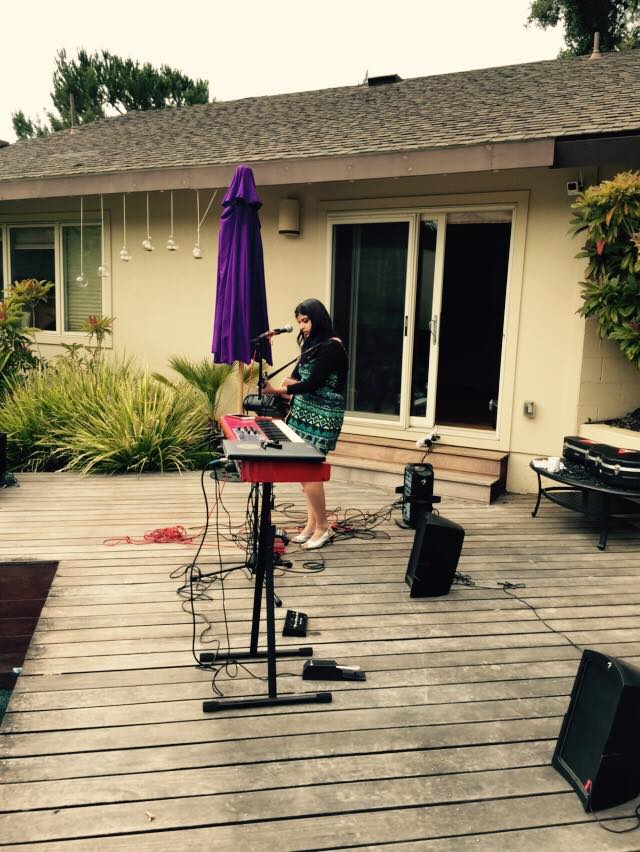
On my US. Tour this summer I experienced both types of house concerts . The first one was a concert cum pool party at my aunt Meera Kaul's beautiful home in Menlo Park, California .We invited a closed guest list of 70 people, her friends, family & my fans and friends in California.
We had a stage by the pool, a minimal sound setup and drinks and snacks for the guests. A CD corner and guest book was setup on the side. We even had a little stall with a few kids selling lemonade and energy bars to raise funds for Nepal. Thanks Meera and everyone that came!
Performing my set at the stage near the pool
Me with Sonia Rao, an L.A. based artist
Casper the doggie welcoming guests
Old friends and new
Arjun and Mythili
Abhishek and his beautiful family
Meera and me with Casper
My next house concert was in Portland, Oregon. This was an example of a house concert where I didn't know my host earlier but reached out to them via the internet.
Group hug- Deva, Bruce and Mary-Ann
I was introduced to my host Deva Gordon (leftmost in the picture) by another lovely generous Portlandier I reached out to online, Bruce Bartlett(center). I hosted a workshop at Bruce's earlier in May and he suggested we do the concert at his friend Deva's home. He asked Deva and she warmly agreed to be host for the evening. So here we were, doing my first house concert in Portland, U.S.A!
Deva's lavender home
The minute I set my eyes on Deva's home, I fell in love with it. I mean seriously..a lavender home with pretty lights and flowers outside..How much cuter can it get really! If a house reflects the people who live in it then I would say that Deva's home described her perfectly. She was incredibly warm and nice.
Setting up the CD display and guest book
Bruce got an amplifier, microphone stand, mics and mixer from his home.We set up quickly and finished soundcheck.
Soundchecking - Processor run through
Setting up the stage
Lets get this show started
Pretty soon the crowd trickled in, and made themselves comfortable at the little parlour in the back.
We had asked the guests to get some food to share with the others. My sister got olives, some cheese and orange juice and Deva made some chia and coconut pudding .
I introduced myself and started playing
We took a break after the first set to interact with the guests and get some food into our hungry bellies!
Free hugs!
After eating Deva's yummy chia pudding
Playing my second set
Albert and his friend
After the quick break, I played my second set and taught the audience the words of a few songs so they could sing along. I love getting people to sing along with me:)
Thanking everyone that came and posing for group pictures post the gig
Some of the guests bought CD's and others made donations. It was really encouraging to see music from across the shores being appreciated in America as well.
My sister and me
I also happen to have the best sister in the world who took all these pictures & drove me to the concert. Thank you sis!
I'll be back next year USA.
Thank you for having me. It's been an honour.
Thanks for coming folks
All in all house concerts are definitely something you should try as an independent artist. Get started today! Good luck and let me know how your concert's went in the comments section below.
One of my life goals is to win a Grammy for my country (someday!) , so you can imagine my excitement when I read about India's big win at the 57th Grammy awards by an indie artist ."Winds of Samsara" by Bangalore based indie composer Ricky Kej and South African flautist Wouter Kellerman won the Grammy award for the 'Best New Age Album '. For someone who's not an Indian classical musician and is not working in Bollywood to have achieved this feat is HUGE! I had to talk to this guy ! I managed to get a phone interview with Ricky to get his insights and advice to other indie musicians on the scene. We talked about the indie scene, copyrighting music, how Bollywood is dominating the Indian scene, distributing music and more.Read on...
Ricky Kej and Wouter Kellerman -Grammy winners for Best New Age Album "Winds of Samsara"
Me:Congratulations on your win Ricky! It's a proud moment for India.What were some memorable moments at the Grammies?Any behind the scenes stuff you'd like to share? Ricky:Thank you. It was very memorable and exciting as you can imagine. The first person who congratulated me backstage was Hans Zimmer.There were a lot of famous people Katy Perry, Sam Smith, Beyonce & Jay-Z that I saw in the audience. You can check out the Grammy acceptance speech on YouTube(below).
Ricky Kej and Wouter Kellerman - Grammy acceptance speech and reaction Me: That's Fantastic!So tell us a little about how you started your music career and some highlights along the way.. Ricky:I would be a part of bands in college . After college I started making jingles for commercials and for the radio. I realised when I started creating my own music that to keep it undiluted (from Bollywood influences) I needed to look for audiences outside India. My music is predominantly Indian and I work with musicians here but my audiences are outside India.I travelled extensively to foreign countries to find my audiences. I would attend music conferences, music concerts, meet other musicians, record labels, distributors.I would find artists that have a similar sound to mine and see how to reach out to their audiences. The last 7-8 years I have found lot of success doing that.
Me: So how did you meet your collaborator Wouter ?Was it on one of your travels?
Dream Team- Ricky and Wouter
Ricky:I had seen Wouter performing at the FIFA closing ceremony in Africa where he played with Shakira. I was a big fan of his work. He had also heard my album "Mesmerising Flute" before and liked my work. We met in L.A. and discussed working together. I had written a song about Gandhi and he had written about Mandela. We worked on each others songs , he adding flute parts to my song 'The Mahatma' and I added Indian parts to his music and we created "Winds of Samsara" together.
Me: So Winds of Samsara was an independent album.How did you release worldwide? Was there any indie label involved? Ricky: The album was an Indian release but it was distributed all over the world. We had separate distributors in America ,Europe , India & Australia . Although it's an indie release , we tied up with a lot of partners and distributors from across the world. We were on Billboard for the top 12 weeks and one of the highest selling New Age Albums in America .We were also the highest played album on radio in America ( #1 on world radio charts for a month)
Me: Thats quite an achievement. So how do you get your songs to play on radios abroad? Do you have to actively promote it or does it get picked up by the radios? Ricky: We contacted radio stations with our CD's directly and they liked the music and played it. It's all about people listening to it on the radio, liking it and purchasing it. At the end of the day, without having a good album and music nothing can come out of only marketing.We put our hearts and souls into our music, spent two years making it , travelled all over the world & collaborated with more than 120 musicians on the album. It was a very uncompromised approach to making music as an art.We made sure that it was exactly the vision we had in mind. Since it was an independent album you're not answerable to anybody but yourself.
Me: You mentioned earlier that the album was made was according to your vision. What was that vision ? Ricky: I wanted to make music from the heart. 99% of the music that sells in India is music for Bollywood. It's almost like an assembly line way of producing music where the music director describes what he wants ,the lyrics writer comes in and then the programmer, playback singer etc add their parts. It's not any one persons vision. If it's not music that comes from the heart it can be very popular music but it is also music that is forgotten easily. Ultimately even though Bollywood music is highly downloaded , the music caters to only the Indian diaspora abroad and is unable to cater to the Western audience.There are very few Indians who break that cultural barrier. Pt. Ravi Shankar for example decided he doesn't want to live in India anymore and Anoushka Shankar who reached out to audiences who are non-Indian in origin. She doesn't live here too because anything non-Bollywood doesn't work in India..for many reasons..the major reason being radio and television will not play her music even though she has an audience here.
Me: Don't you think however that the Indie scene is changing in our country, with channels such as MTV Indies and VH1 airing indie songs and platforms such as OKlisten and ArtistsAloud distributing independent music? Ricky: I disagree. The scene is getting worse. In the early 2000's a lot of Indie musicians were coming out like Adnan Sami, Shaan and Agnee and their videos would play on TV. Now you hardly see anybody and if you do people ask "Who is this person"?
Right now the industry here has reached a stage where if you're a composer the first question that somebody asks you is "Which films have you composed for ?" and if you're a singer then it's "Which films have you sung playback for?" Everything is associated with the film industry.We have music awards and 90% of them are film awards. People want to see Bollywood celebrities in the audience else T.V. channels don't pick up shows for airtime. Awards ceremonies in the USA(Grammy) Canada(JUNO),South Africa (SAWA) and others are based entirely on the music.There are only a sprinkling of movie stars in the audience. A country like America ..their whole history is chronicled through music .When Adele and Sam Smith broke up with their boyfriends they wrote albums about it..these are real things that people connect with.
I definitely didn't want to go the Bollywood route because if I make one song thats a hit I don't want people to associate that with who I am as a personality.
Me: You haven't composed for Bollywood but you have composed for a few Kannada films and released music with Universal. Did you have to compromise on your style of making music for any of these ventures? Ricky : I released some albums with EMI . The head of EMI at the time Suresh, already liked my music a lot so he asked me to compose pieces that were based on the music I was already making . I made about 21-30 songs for them and they didn't request for any changes when I gave them the masters. They would only change the titles of some of the songs and the song order according to how they wanted to market it.That was ok with me as they are the experts in marketing and my music was untouched.All three Kannada films I did were with a very visionary director who I enjoyed working with and who let me retain my musical style.
Me: There's a big debate amongst independent musicians on whether to stay indie (given the resources we have at our disposal today) or associate with a label. What's been your experience with both? Ricky:It's very important to remain an independent musician nowadays. You have to own the rights to your own music. In the case of EMI, they gave me a production fee to create the album and a percentage of the sales. The EMI head had a vision to look outside Bollywood. I also did work for Universal in USA and so was not a newcomer. EMI contacted me because I was already established in the instrumental music industry
Me:Most of the music channels like Vh1 are playing pop and other mainstream stuff..Where do other genres like New Age ,Metal,Jazz etc get heard by consumers? Ricky:Consumers that are into other genres of music know exactly where to look for that kind of music. Be it Metal, Jazz, World music there are specific radio stations, cable networks and channels that will play these genres of music in America and the consumers will know where to find it. These are niche genres and consumers know that they won't find it on network television. In India we don't have these channels yet. The only option here is Itunes.
Me: Where can Indians discover music from niche genres such as yours to listen to? Online radios? Itunes channels? Ricky: Social media is the best bet. In America, it's on radio. In India there are no dedicated radio stations that play anything other than film industry music, so discovery is almost impossible here.
Me: In India, many indie musicians are now looking at making music a full time career.What are some ways to make it a sustainable career choice? Ricky: If you're an indie musician it's important to have perseverance and patience. I think it's very important NOT to have a day job .If you do you're not being faithful to either of your professions . You'll never have enough time to do your music, you never have enough time to network.You need time to rehearse, meet other musicians and collaborate. Having a day job is a major handicap and your music career will never be successful.
Me: I think the main problem people have leaving their day jobs for music is assurance of a basic salary to meet living expenses..where will the money come from? Ricky: There are sacrifices you have to make. It depends on how badly you want to make it in your career. There will be times when you will have no money at all. If you've not started a family yet, sometimes even that needs to be sacrificed.You have to see what is more important to you and what you are more driven about. Drive and discipline are extremely important for a musician. An engineer studies for 4 years and then gets a job ; a musician expects to start making money the next day! Thats not going to happen.You need to have a music education, start off with low paying gigs, move up the ladder,then as you get famous you make more money.
At the end of the day a lot of people use creativity as an excuse for laziness.You have to be far more disciplined than you would ever be in a day job.
I've been doing this for 16 years. I studied dentistry but decided to do music. Imagine if I had left after 4 years saying nothing is happening... I would have never won a Grammy.
Me: A musicians life is full of highs and lows. What motivated you through life's lows? Ricky: I would write music about it. I would use even those moments to keep making music.
Me: Some independent artists were approached by a music company in Mumbai to sell them their songs. What do you think about an artist selling their songs to other people (Bollywood/other composers)? Ricky: You can make songs for other people but the intellectual property rights for those will always be yours. It's illegal for someone to pay you X amount of money for your songs and own the intellectual property rights.There is a law passed in India against that. You can sue the company if it specifies in the contract that they will own the IPR of the song.
Me: That's a very informative tip for a lot of indie musicians. How did you copyright your music to protect it? Ricky: You don't need to copyright your music , you need to register your songs with IPRS in India ( http://www.iprs.org/cms/). I registered my songs with an organization called BMI ( http://www.bmi.com/) in the US (for US citizens only). It's completely free of cost.Whenever people put it on Radio,TV, or use the song online BMI collects the money on the artists behalf. When I signed up with them , the very next day they were collecting money from the last 10 years for my music
Me:What are some ways more Indian musicians can get their music heard globally? Ricky:You have to travel to meet people, collaborators and other musicians in different countries.You also have to use social media. I may be completely wrong but it's next to impossible to make a living as an independent musician in India.You can live here and make your music here but you should get revenues from outside India. India is still not the best environment for an independent musician because sales are really dismal in India due to it's focus on Bollywood.Piracy is also very high here.If I'm speaking to someone about my album in a foreign country, they would preview it on Itunes and then buy it. Here people ask me "Could you share the Mp3's with me on my pendrive?" No one looks at music here as a commodity they have to pay for. Bollywood doesn't care about piracy because music for them is a means of marketing their movie; their profits come from ticket sales and not as much from music sales.As a result there is a culture around free content being available online for download . Ultimately this affects the income of independent artists as well.
Me: Should people even make physical albums anymore or just sell their music digitally?Are albums on their way out? Ricky: Physical albums will always be important. It's a very easy way to purchase music if people are in a store or to give your music to a promoter.It's also something you can touch, feel and gift wrap as a present to someone. Digital is the future. As houses will become smaller, having a CD collection will be a hassle.
Me: Where do you think the music scene in India is headed? Ricky: It's headed more towards the film industry. There will always be bursts of independent movements in India but the movie industry is here to stay.
Me: Whats your advice to independent musicians from India that would like to follow their passion ? Ricky: Look outwards. They will have to make it big in other countries. India is not the place to be for independent music. If you want to be an independent musician here you will have to be a part of the movie industry. You have to be extremely perseverant, find mentors in the industry and truly believe in your music to succeed as an independent artist.
Me:What are your future plans? Ricky:I've received validation for my kind of music and I am going to continue to make it to whoever wants to listen to it..in India or abroad. If India wants to listen to it I would be thrilled because everybody wants recognition in their own country. I have a fan following in China, Austrailia and the USA so I'm happy to keep catering to them too.
Me: Thank you Ricky for your insights and for inspiring a lot of indie musicians to dream big. Ricky: Thank you!
I hope this interview helped you with some insights into the music industry and the Indian music scene. If you have any questions do type them in the comments section below. We would be happy to answer them! Do share the article with any musician friends you know. Knowledge is power.
P.s. Oh and if you liked the blog could you follow it please :) Ok bye!